
School and Classroom Lighting Standards in the UK: What to Specify and Why
The lux levels, glare limits and control requirements for classrooms, halls, labs and corridors in UK schools — from BS EN 12464-1, SLL Lighting Guide 5 and the DfE's output specification — and the fittings that meet them on a school budget.
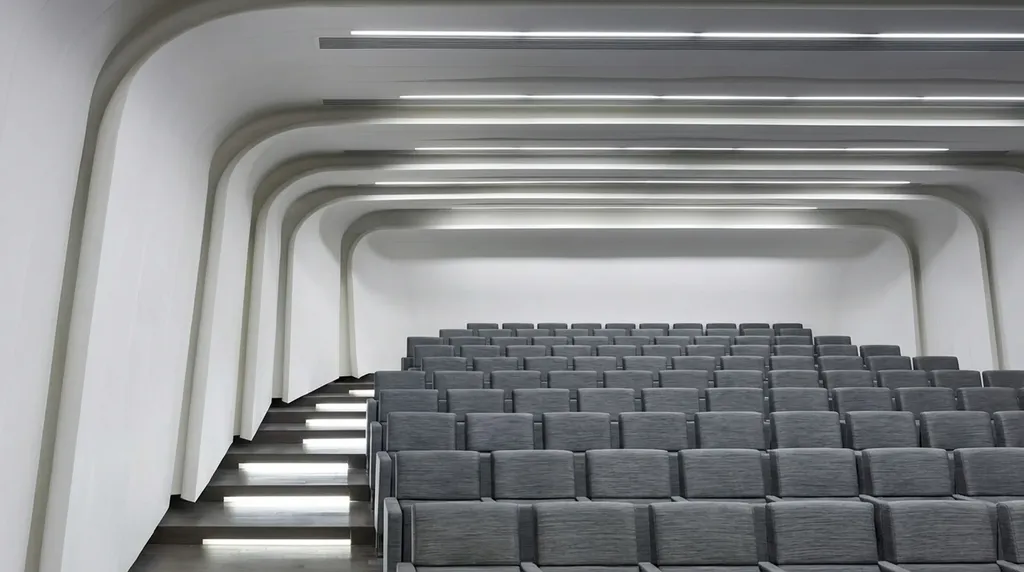
School lighting has to do more than most: keep thirty pupils alert through a wet afternoon, make a whiteboard legible from the back row, survive a corridor at break time, and do it all within an energy budget that a bursar will scrutinise every year. Three documents set the standard in the UK. BS EN 12464-1 gives the lux, glare and colour figures for educational spaces. The Society of Light and Lighting's Lighting Guide 5: Lighting for Education interprets them for real schools. And for new-build and major refurbishment, the Department for Education's School Output Specification turns them into contractual requirements, including daylight and controls. Here is what they ask for and how to meet it.
Lux levels by space
- General classrooms: 300 lux maintained on the desks is the long-standing UK figure in LG5 and the DfE output specification; BS EN 12464-1:2021 now lists 500 lux for classrooms, keeping 300 lux for nursery rooms, so check which document a project is contracted to. Glare no higher than UGR 19; colour rendering Ra 80 or better.
- Whiteboards and teaching walls: good vertical illuminance on the board — the DfE annex asks for 150 lux and BS EN 12464-1 for 500 lux — with no reflected glare from the fittings, which usually means a dedicated asymmetric board light or a carefully placed row.
- Science labs, art rooms, food technology and design workshops: 500 lux, with 750 lux for technical drawing and fine work; Ra 90 where colour judgement matters, as in art.
- Lecture theatres and libraries: 500 lux on the reading plane, with dimming for presentations.
- Sports halls: 300 lux for PE and community use (the BS EN 12464-1 and Sport England figure; EN 12193 Class III for badminton), with ball-proof, impact-rated fittings.
- Corridors, stairs and circulation: 100 lux in corridors, 150 lux on stairs, with good uniformity and IK-rated fittings at pupil height.
- Halls, dining and assembly: 200–300 lux, flexible and dimmable, since the same space hosts exams, lunch and a school play.
Glare, flicker and colour
Children spend more of their day looking up at a teaching wall than adults spend looking up at anything, so glare control is not a refinement in a classroom; it is the difference between a room that works and one that gives headaches. Specify UGR 19 fittings with microprismatic or louvred optics, calculate the UGR for the actual room, and keep the luminaire luminance low at the angles that reflect in interactive screens. Drivers should be flicker-free — a modulation that adults do not notice can affect concentration and is a known trigger for some pupils — and colour temperature of 4000 K with Ra 80 is the usual choice, with some schools now adopting tunable white to warm the light through the day.
Daylight and controls
The DfE's output specification expects classrooms to be daylit to defined targets and the electric lighting to respond to it. In practice that means daylight-linked dimming on the window rows, absence detection everywhere — lights come on by a switch and go off when the room empties, which suits how classrooms are actually used — and presence detection in toilets, stores and corridors. Our guide to occupancy and daylight sensors covers the commissioning that makes the difference between controls that save energy and controls that get taped over. Part L applies as to any non-domestic building, and the savings are large: a school's lighting runs perhaps 1,500 to 2,000 hours a year, but a great deal of it in rooms that are empty for part of the day.
Robustness, safety and maintenance
Fittings in corridors, stairwells, changing rooms and sports halls need impact ratings — IK08 as a minimum, IK10 where reachable — and ball-proof certification above any court. Diffusers in classrooms should be TP(a) rated, which Approved Document B allows without the area and spacing limits it places on TP(b) — and neither is permitted in a protected stairway. Emergency lighting to BS 5266-1 covers escape routes, halls and stairs, with the monthly and annual tests logged for the fire risk assessment. And because schools cannot easily take rooms out of use for maintenance, long-life LED with a five-year warranty and a spare-parts commitment matters more here than almost anywhere.
Fittings that meet the brief
For classrooms with suspended ceilings, microprismatic LED panels at UGR 19 with DALI or absence-sensor control are the workhorse; where ceilings are plasterboard, exposed or high, surface or suspended linear luminaires with direct/indirect distribution give a brighter, calmer room for the same lux, a comparison drawn in more detail in our panels versus linear article. Sports halls take impact-rated high bays or linear fittings with guards; corridors take IK10 battens or bulkheads; external routes and playgrounds take full cut-off area lighting with a curfew.
A classroom lit to 300 lux is compliant. A classroom lit to 300 lux with no glare on the board, no flicker and lights that switch themselves off at four o'clock is a school lighting scheme.
Most UK schools are lit by a mixture of ages of fluorescent fittings, and the fluorescent phase-out is forcing the question of what replaces them. Done well — to LG5 and the output specification rather than like-for-like — the replacement improves the teaching environment and cuts the lighting bill by half or more. Regents LED supplies the education sector with panels, linear, sports hall and external ranges, and will produce a room-by-room lux and UGR calculation for a school from its floor plans, phased for holiday working.