
UGR Explained: Glare Ratings for Offices and Workplaces
"UGR less than 19" appears on almost every office lighting specification. Fewer people can say what it measures, why 19, or why it is not strictly a property of the luminaire at all.
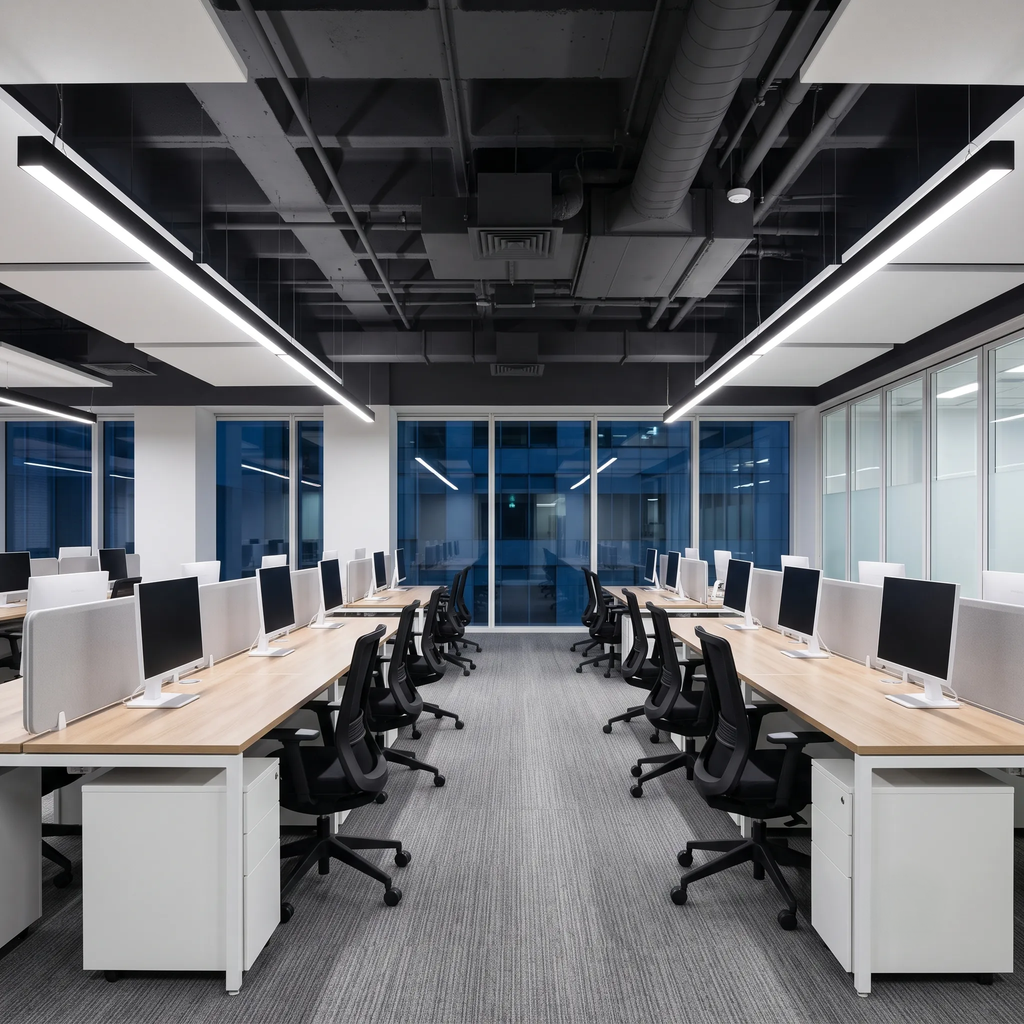
Glare is the discomfort or loss of visibility caused by a bright source in the field of view, and in a modern office it is one of the most common lighting complaints. The Unified Glare Rating, or UGR, is the method European standards use to put a number on it. It is a useful tool — but it is widely misread as a simple product rating, and that misreading leads to specifications that look compliant on paper and glare in practice.
What the number means
UGR is a scale that runs from around 10 (imperceptible) to 30 (intolerable), calculated using a formula published by the CIE. It weighs the luminance of each luminaire in view, how large it appears, where it sits relative to the line of sight, and the brightness of the background it is seen against. Steps of three are meaningful: 13, 16, 19, 22, 25 and 28 are the values that appear in standards, and a change of one unit is barely noticeable. BS EN 12464-1 sets maximum UGR values by activity — 19 for offices, reading and writing; 16 for technical drawing and fine inspection; 22 for reception areas and general industrial work; 25 for rough work and warehousing; 28 for corridors. Nineteen is the office figure because it is the level at which most people doing sustained screen and paper work stop noticing the lighting.
Why it is not a luminaire property
Here is the part that matters. UGR is calculated for an observer in a room: it depends on room size, surface reflectances, mounting height, spacing and viewing direction as well as on the fitting. The same luminaire can produce a UGR of 17 in one room and 23 in another. When a datasheet says "UGR < 19", it is reporting the result of a standardised tabular calculation — usually a room of set proportions with 70/50/20 ceiling, wall and floor reflectances, viewed crosswise and endwise — not a guarantee about your space. A large, dark-ceilinged, open-plan floor with fittings on a wide grid can push a "UGR < 19" product well over 19. The tabular figure is a reasonable filter for choosing candidates; it is not a substitute for a calculation of the actual layout.
Why LED made glare harder, not easier
Fluorescent tubes were large, low-luminance sources. LEDs are tiny, extremely bright points, and a bare LED board is far more glaring than a tube of the same total output. Everything that sits in front of the LEDs — the diffuser, microprism panel, lens or louvre — exists to spread that brightness over a larger area and to cut off the light at the high angles where it enters the eye. Those optics cost efficacy. A microprismatic panel might give up a few percent against an opal one, and a louvred fitting a little more, in exchange for a materially lower UGR. When a low-glare fitting and a high-efficacy fitting are being compared on lumens per watt alone, the comparison is missing the point.
Screen work adds a second consideration. Because reflections of luminaires in monitors are their own source of discomfort, BS EN 12464-1 also limits luminaire luminance at high viewing angles for spaces with display screens. Low-UGR optics generally address this too, but it is worth confirming on the photometric data rather than assuming.
Getting it right on a real project
- Use the tabular UGR to shortlist, then have the layout calculated. A designer with the IES or LDT file can report UGR for the actual room, at the actual desk positions, in both viewing directions.
- Watch the room, not just the fitting. Dark ceilings and walls raise UGR because they lower the background luminance the fittings are seen against. Lighter finishes and a little uplight both help.
- Consider mounting height and spacing. Lower mounting brings fittings nearer the line of sight; raising them generally helps, though the higher-output fittings a taller room demands can cancel the benefit. Tighter spacing with lower-output fittings usually rates better than a sparse grid of bright ones.
- Do not accept UGR < 19 as a blanket claim for a product family. It applies to a particular optic at a particular output; the same body with a clear diffuser or a higher-lumen module may not comply.
- Remember what 19 is for. Corridors, stores and plant rooms do not need it, and paying for low-glare optics there buys nothing. Meeting rooms, open-plan desks and anywhere people spend hours reading do.
UGR describes a room with fittings in it, not a fitting in a box. The datasheet figure gets a product onto the shortlist; only the calculation gets it onto the ceiling.
Glare complaints are among the hardest to fix after handover, because the remedy is usually a different optic or a different layout rather than a setting change. That makes UGR one of the better places to spend a little design effort up front. Ask for the photometric file, ask for the calculation, and ask which room the "< 19" was worked out for. The answers take a few minutes and can save a refit.