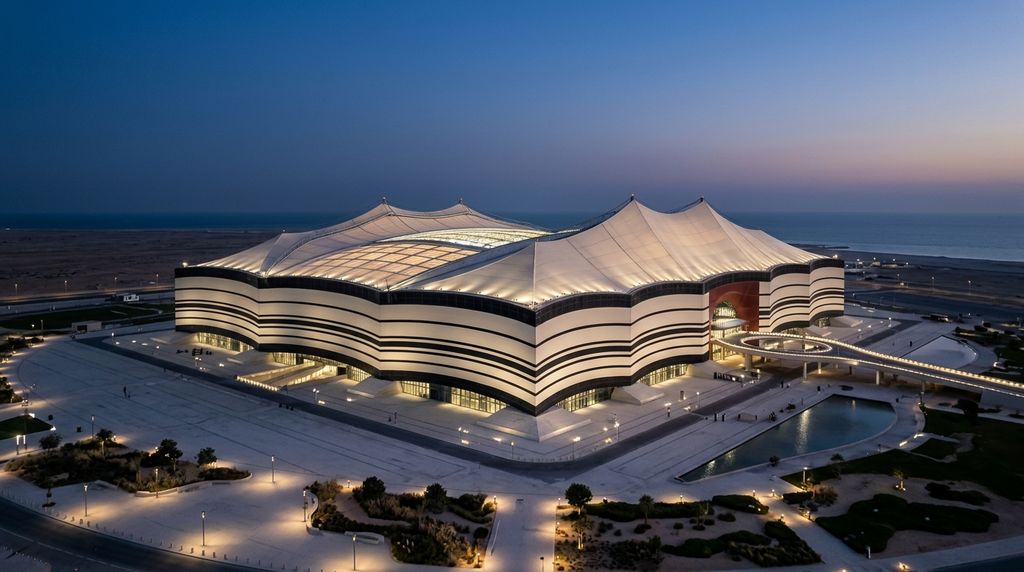
Al Bayt Stadium
Sports & Recreation · Doha,Qatar
COMPLETED 2021
Al Bayt Stadium takes the form of a Bayt Al Sha’ar, the black-and-white tent that nomadic communities have pitched across Qatar’s deserts for generations. Designed by Dar Al-Handasah and set in Al Khor, 35 km north of Doha, it seats 60,000 and was inaugurated on 30 November 2021. Its striped, PTFE-finished skin gives it a tent’s silhouette, while its interior carries the woven Sadu patterns of Qatari craft. Around it, Al Bayt Park adds 400,000 m² of green space with running and cycling tracks. That architecture sets the lighting brief. At night the stripes must read as cloth and not as a floodlit wall, the Sadu-patterned concourse must stay warm and welcoming under crowd conditions, and the park must stay legible without competing with the stadium on the horizon. This presentation explores how the Regents LED range could answer each of those three conditions, with products selected from the catalogue and verified against their published specifications.
Exterior façade, the striped tent-form skin
The Tent That Holds the Light
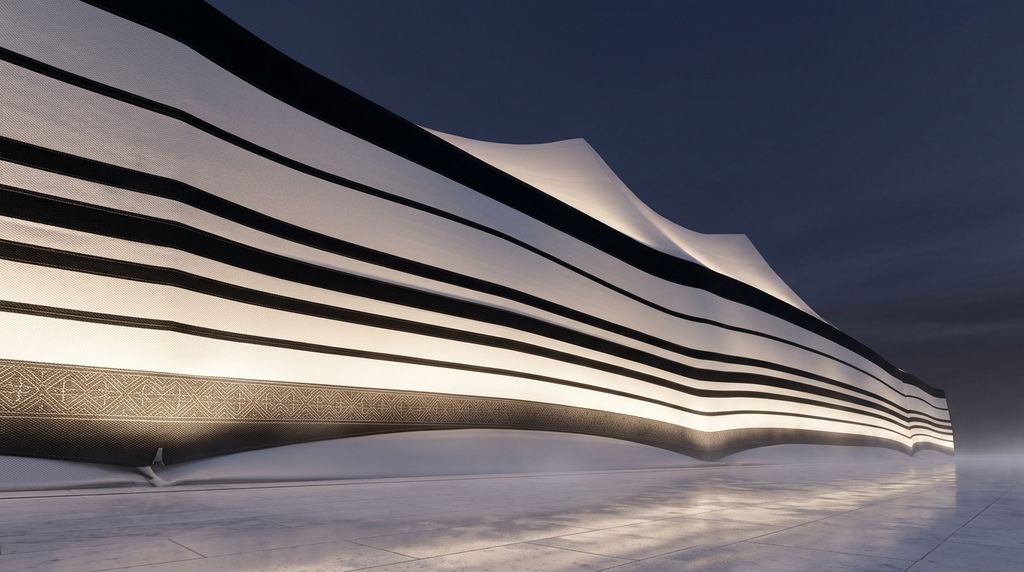
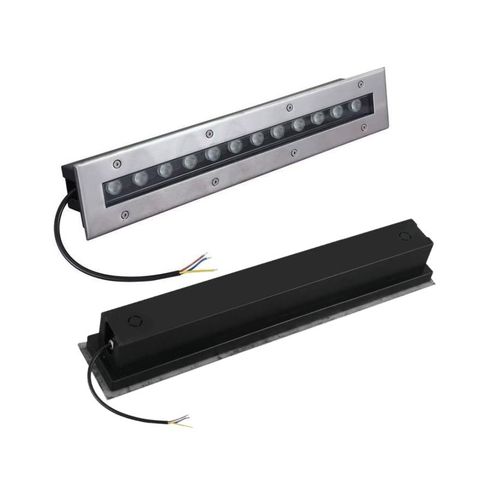
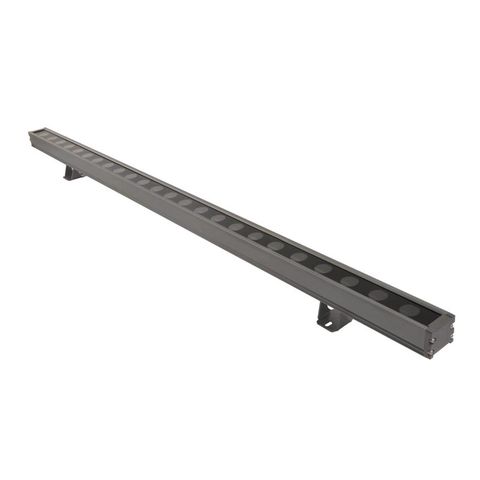
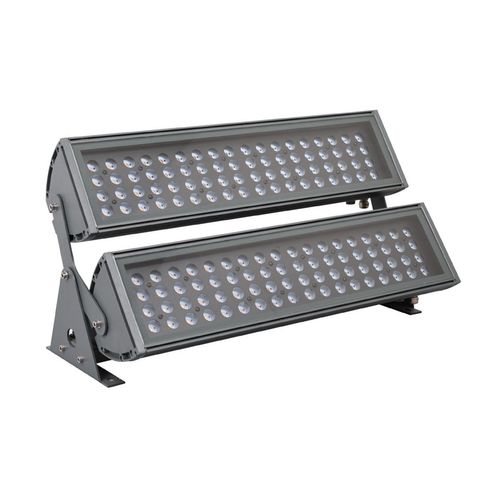
A tent-form stadium presents an unusual lighting problem, because here the surface is the architecture. Al Bayt’s white and deep-navy striped skin has to read as woven cloth after dark, not as a wall being floodlit, so the light must arrive low, shallow and even. At the plinth line, RL-RECWW-01 is the catalogue answer: an IP67 wall washer recessed at the foot of the façade, with 10°, 30°, 45° or 60° optics that let a narrow beam climb the pale bands and pick out the weave. Where a recessed position is not possible, RL-SMWW-02 is the closest equivalent, with the same beam options at IP65 in a body only 32 mm high. Higher up, the roof edge needs a longer throw. RL-FL5222 is adjustable from 5° to 90°, so the narrowest optic can reach the upper membrane while a wider one softens the ridges, and its CRI above 90 keeps the white fabric neutral.
Concourse and Sadu interior
Woven in Warm Light
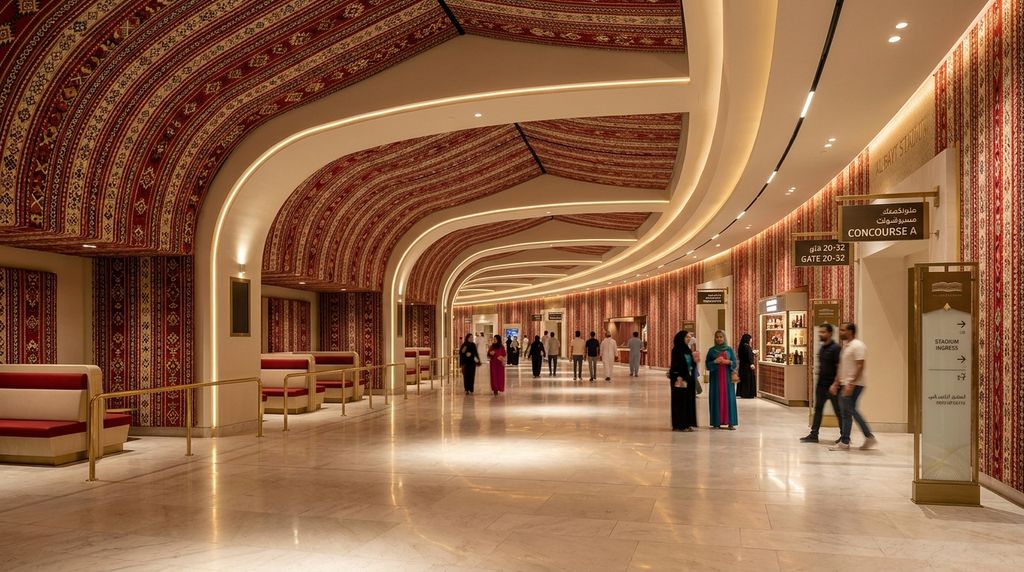
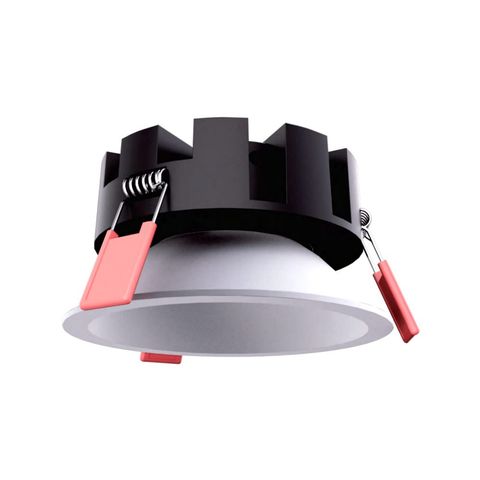
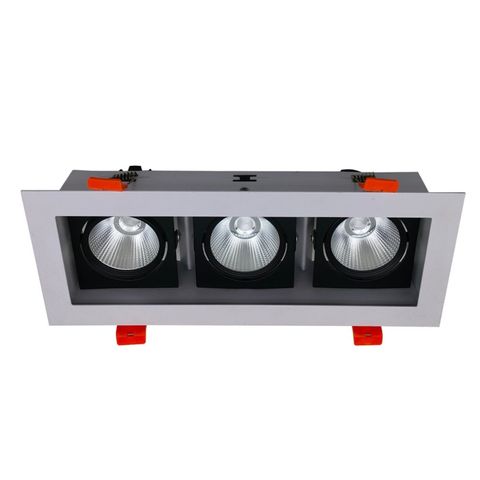
A concourse has to work at two speeds: a trickle of early arrivals two hours before kick-off, and tens of thousands moving through it at once afterwards. Al Bayt’s concourse adds a third demand, because its walls and vaults are dressed in Sadu weaving, a pattern of red, cream and fine geometry that turns flat and brown under poor light. The general layer therefore has to be quiet and well rendered. RL-DL1599 is the catalogue answer. It stands only 45 to 49 mm tall and needs a cut-out of 55 to 85 mm, so it sits in a shallow ceiling void without a deep plenum. Its CRI above 90 keeps the reds true instead of orange, and its 20°, 40° or 60° optics let the spacing follow the width of the walkway. Where the route meets the textile walls, RL-DL1700 supplies the accent. It is adjustable, with optics from 15° to 50° in two- and three-head formats, so light can be turned from the floor onto the weave and the pattern read as texture rather than as a flat wash. Both are dimmable by 0–10V, 1–10V or DALI with the driver included, so the concourse can sit at a calm level on a quiet day and be brought up as the crowd arrives.
l Bayt Park and grounds, the stadium seen across the lawns
A Lantern in the Park
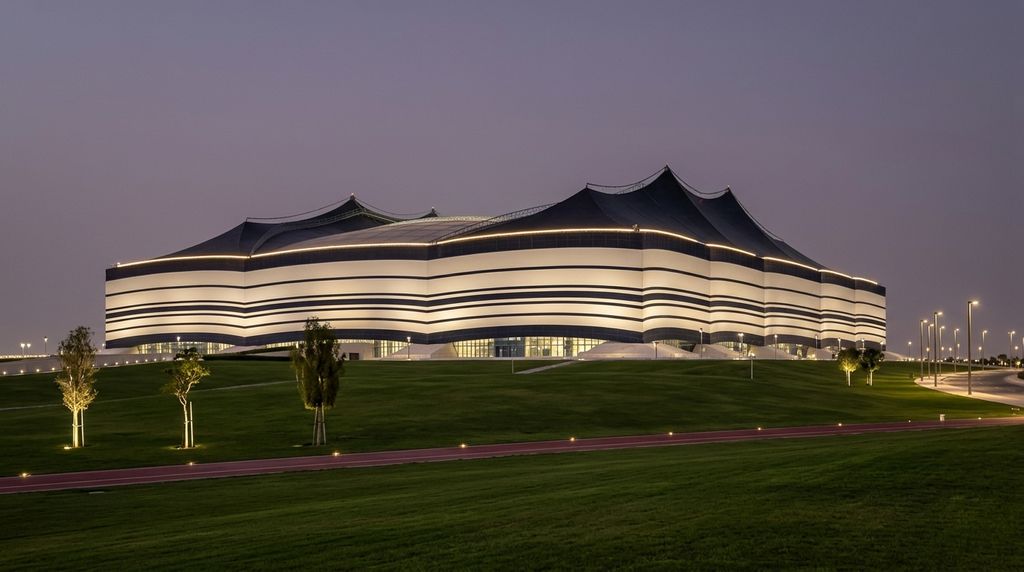
Seen across the 400,000 m² of lawns in Al Bayt Park, the stadium stands on a low rise like a vast, glowing landmark. Opened in February 2020 alongside running tracks, play areas, and restaurants, the park relies on landscape lighting designed for one purpose: to guide the eye toward the architecture without competing with its presence.
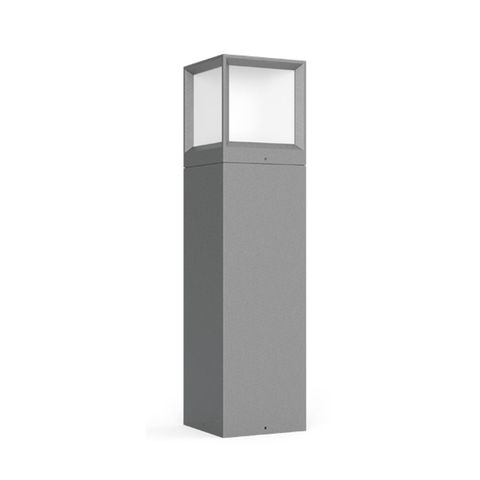
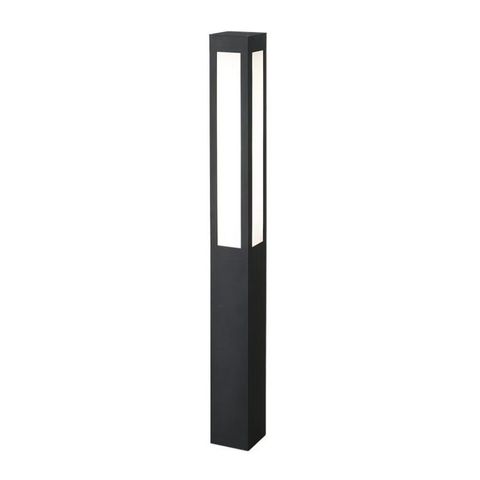
Along the running and cycling tracks, the rl-bl3286 marks the edges with low-glare, subtle points of light to keep the pathways clearly defined. For broader pedestrian routes across the precinct, the rl-bl3289 provides continuous linear guidance integrated directly into the paved surfaces.
On the surrounding slopes, the rl-bl3294 accentuates the young trees from below. Its narrow, adjustable beam illuminates the trunks and lower canopy without spilling light onto the surrounding grass. Because every fixture is fully dimmable, the park’s light levels can be reduced late at night, leaving the illuminated stadium façade as the dominant feature on the horizon.