
Outdoor Lighting and Light Spill: Obtrusive Light, Dark Skies and Colour Temperature
Outdoor lighting is judged by the people who did not ask for it: the neighbours, the planners and the wildlife. Getting the light where it is needed, and nowhere else, is now a specification requirement rather than a courtesy.
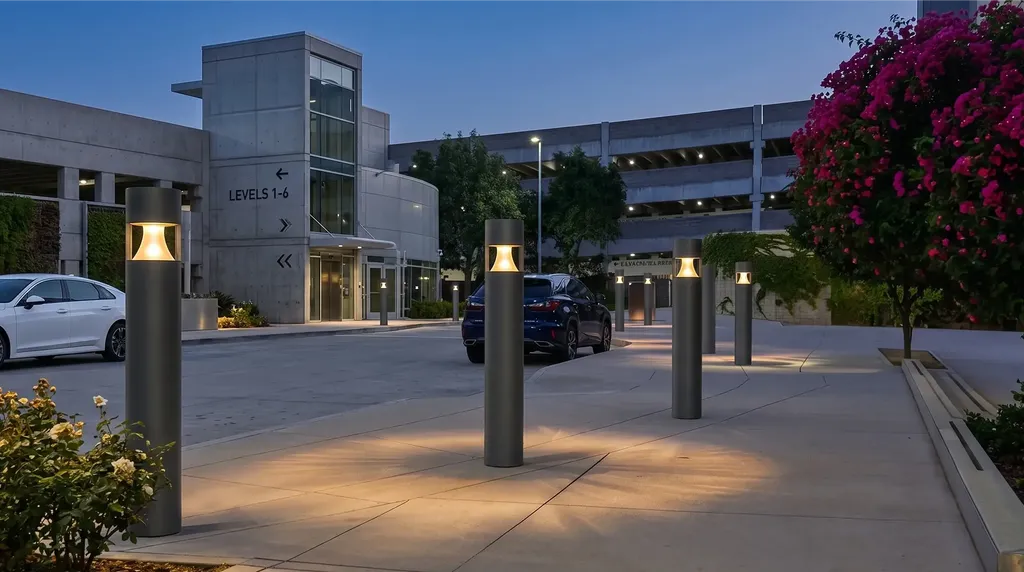
For most of the last century, an outdoor lighting scheme was considered successful if the car park was bright. That is no longer the whole test. Light that spills into bedroom windows, glares at drivers, washes out the night sky or floods a hedgerow at 2 a.m. is now recognised as a nuisance, a planning issue and an ecological problem — and in England and Wales, artificial light from premises can be a statutory nuisance in the same legal category as noise, with exemptions for certain transport and other premises. A modern outdoor specification has to deliver the illuminance the site needs while controlling what happens to the light beyond the boundary.
Obtrusive light and the environmental zones
The reference document in the UK is the Institution of Lighting Professionals' Guidance Note 01, The Reduction of Obtrusive Light. It classifies locations into environmental zones from E0 — protected dark-sky places such as designated International Dark Sky Reserves and Parks — through E1 (intrinsically dark: national parks, AONBs and uninhabited rural areas), E2 (low district brightness, villages and rural edges) and E3 (medium, suburban) to E4 (high district brightness, town and city centres). For each zone it sets limits on the upward light ratio — the proportion of a luminaire's output that goes above the horizontal — on the vertical illuminance at neighbouring windows, on the intensity of luminaires seen from outside the site, and on the luminance of lit building facades and signs. The limits tighten sharply after a curfew — commonly set by the planning authority somewhere between 21:00 and 23:00 — which is where dimming and switching schedules earn their keep. Planning authorities routinely attach these limits as conditions, so a scheme should be designed and calculated against the correct zone from the start.
Aim the light: optics, tilt and cut-off
Most spill comes from luminaires that are tilted upward or that emit light at high angles. The remedy is well established: flat-glass, full cut-off luminaires mounted horizontally, with zero upward light, and asymmetric optics that throw light forward across the area to be lit without needing the fitting to be tilted. A floodlight aimed at 30° above horizontal to reach the far side of a yard will put a substantial fraction of its output into the sky and the neighbours' windows; the same yard lit from a column with a forward-throw optic at 0° tilt will not. Shields, louvres and back-light control accessories deal with individual problem directions. Column height and position matter too: fittings placed on the boundary looking inward light the site and only the site, while fittings in the middle looking outward light everything.
Colour temperature: warmer is better outdoors
Cool white light — 5000 K and above — was the default for early LED street and area lighting because it delivered the most lumens per watt. It has fallen out of favour for good reasons. Short-wavelength blue light scatters more in the atmosphere and so contributes disproportionately to sky glow; it is more disruptive to nocturnal wildlife, particularly bats and insects; and it is experienced as harsher glare by people. Dark-sky guidance now recommends a correlated colour temperature of 3000 K or warmer for outdoor lighting, and ecological guidance — including the ILP's joint note with the Bat Conservation Trust on bats and artificial lighting — commonly asks for 2700 K or below near sensitive habitats, along with lower mounting heights and strict curfews. The efficacy penalty of warm white LEDs is now small, and in most applications the trade is worth making without a second thought.
Controls: the light that is not on cannot spill
The simplest way to meet post-curfew limits is to reduce output after the curfew. Time-based dimming — for example to 50% after 23:00 and to a minimum security level after midnight — is built into most modern outdoor drivers and can be set on the fitting or through a control system. Presence detection on bollards, pathways and car parks brings light up when someone is there and lets it fall away when they leave, which suits security as well as spill. Where a site is empty overnight, the answer may simply be off.
A practical checklist
- Establish the environmental zone with the planning authority before the design starts, and design to the ILP GN01 limits for that zone, pre- and post-curfew.
- Specify full cut-off, flat-glass luminaires mounted at 0° tilt, with asymmetric optics doing the work that tilt used to do.
- Choose 3000 K or warmer as the default, and 2700 K or below near watercourses, woodland edges and known bat habitats.
- Provide a calculation showing horizontal illuminance on the site and vertical illuminance at the nearest windows, so the planning condition can be demonstrated rather than asserted.
- Build in dimming and a curfew schedule, and presence detection where the site is intermittently used.
- Check IP and IK ratings, surge protection and ambient temperature ratings for the location — outdoor fittings live a harder life than the datasheet's laboratory.
Good outdoor lighting is measured twice: once on the site, where it should be, and once at the boundary, where it should not.
None of this makes outdoor lighting harder to do; it makes it more precise. The same tools that deliver an evenly lit car park — decent optics, sensible column positions, a calculation and a control schedule — are the tools that keep the light out of the sky and the bedroom next door. A specification that names the environmental zone, the colour temperature and the curfew is, in practice, the specification that gets through planning without a second round.