
LED Street Lighting for Private Roads, Estates and Business Parks: A BS 5489 Specification Guide
How to specify LED street lighting for a housing development, private estate road or business park to BS 5489-1:2020 — lighting classes, column heights, colour temperature, dimming and the details a highway authority will look for at adoption.
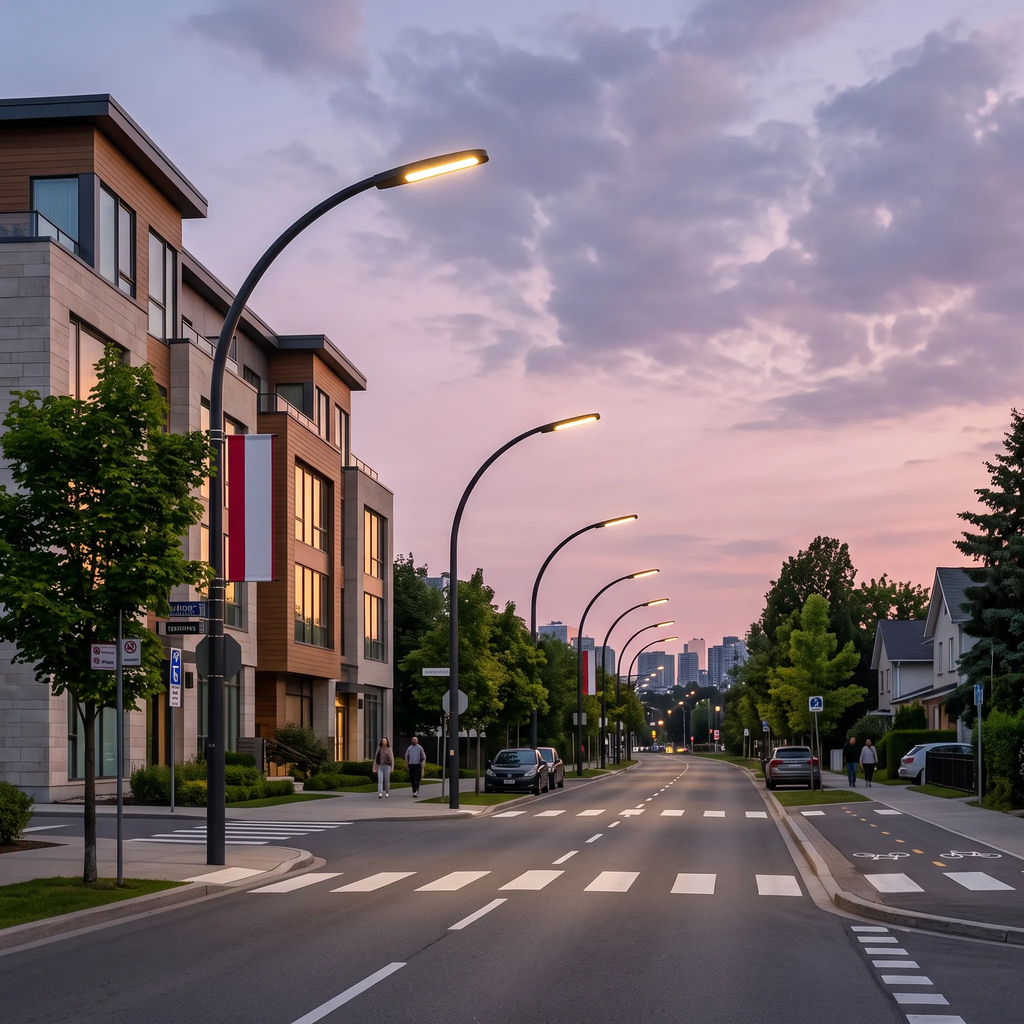
Street lighting on a new housing development, a private estate road, a business park or a campus is specified far more often by developers, contractors and facilities managers than by highway engineers — and it is judged by the same standard either way. BS 5489-1:2020, Design of road lighting — Lighting of roads and public amenity areas, is the UK code of practice, and it is what a highway authority will check against if the road is ever offered for adoption under a Section 38 agreement. Specifying to it from the start avoids the expensive discovery, years later, that a private road's lighting has to be replaced before anyone will take it on.
Lighting classes: M, C and P
BS 5489-1 selects a lighting class from the European framework in BS EN 13201 according to the road's traffic, speed, use and surroundings. M classes apply to traffic routes and are defined by road-surface luminance — the domain of highway authorities rather than developers. C classes cover conflict areas such as junctions and roundabouts. P classes are the ones that matter for residential streets, estate roads, footpaths, cycleways and car parks: they are defined by horizontal illuminance, from P1 at 15 lux average down to P6 at 2 lux, each with a minimum point value. A typical residential estate road lands in P4 or P5 — 5 lux or 3 lux average, with minimums of 1 lux and 0.6 lux — while a business park spine road with more traffic and pedestrians at shift change may warrant P3 or a C class. Earlier editions let designers drop a P class for white light with a high S/P ratio; BS 5489-1:2020 removed that adjustment, so the selected class is now designed to in full, and the 2020 edition adds a maximum threshold increment (a disability-glare limit) for each P class, which bears on luminaire choice.
What the specification needs to cover
- Luminaire: an LED street light with a flat glass, full cut-off optic and a road-lighting distribution matched to the column spacing and road width; IP66, IK08 or better, 10 kV surge protection, a marine-grade finish near the coast, and a driver with dimming (DALI or 1–10V) and a photocell socket to the NEMA or Zhaga standard so controls can be added later.
- Colour temperature and rendering: 3000 K is now the default for residential areas and anywhere near housing or habitats, 4000 K is acceptable on business-park roads; Ra 70 or better. Many authorities have moved to 2700 K–3000 K on dark-sky and ecological grounds, and the ILP's guidance points the same way.
- Columns: 5 to 6 m in residential streets and footways, 8 to 10 m on estate spine roads and business parks; steel or aluminium to BS EN 40, root-mounted or flange-mounted, with passive safety considered where vehicles pass at speed. Spacing follows the photometric calculation, not a fixed rule.
- Controls: part-night dimming — typically to 50 percent between midnight and 05:30 — is now standard practice and expected by most authorities; presence detection on footpaths and car parks where use is intermittent.
- Electrical: Class I or Class II luminaires with double-pole isolation at the column, cut-outs to BS 7654, and a private-cable network designed to BS 7671, with the feeder pillar sized for LED loads and any future EV or CCTV demand.
- Obtrusive light: design to the ILP's environmental zone for the site — E2 for a rural-edge development, E3 for suburban — with the spill, upward light and glare limits demonstrated in the calculation.
Adoption: designing for the highway authority
If there is any prospect of the road being adopted, obtain the local highway authority's lighting specification before designing. Most publish one for Section 38 and 278 works, and they are specific: approved luminaire families, column suppliers, colour temperature, dimming profile, connection to the authority's central management system, and a commuted sum for future maintenance. A scheme designed to the generic standard but not to the authority's specification can still be rejected. Where a road will remain private — a gated development, a business park, a campus — the owner is free to choose, but BS 5489 remains the reasonable benchmark for safety and for any dispute about adequacy.
Footpaths, car parks and amenity areas
BS 5489-1 covers more than carriageways. Footpaths and cycle routes are P classes with an emphasis on facial recognition, which the standard addresses through semi-cylindrical illuminance and colour rendering rather than average lux alone. Car parks are amenity areas with their own class selection, discussed in our guide to car park lighting requirements. Around buildings, bollards, step lights and wall lights light the pedestrian scale that columns cannot, and are chosen on the same principles: full cut-off, warm white, robust, and dimmed or switched when the space is empty.
A private road is lit to BS 5489 for the same reason a public one is: so that people can see, be seen and get home. Designing to it from day one is also the only way the road will ever be adopted.
LED has made good street lighting cheaper to run, easier to dim and far kinder to the night sky than the sodium and metal halide it replaced, but only when it is specified as a system — luminaire, column, optic, colour and control together. Regents LED supplies street and area lighting for the public realm and urban sector and will produce the BS 5489 calculation, column schedule and obtrusive-light figures for a development or estate from the site layout, ahead of any highway-authority submission.