
L70, L80 and B10: What LED Lifetime Claims Actually Mean
"50,000 hours" is the most quoted number in LED lighting and one of the least understood. It is not the point at which the light stops working — and it is not always the point at which it stops being useful, either.
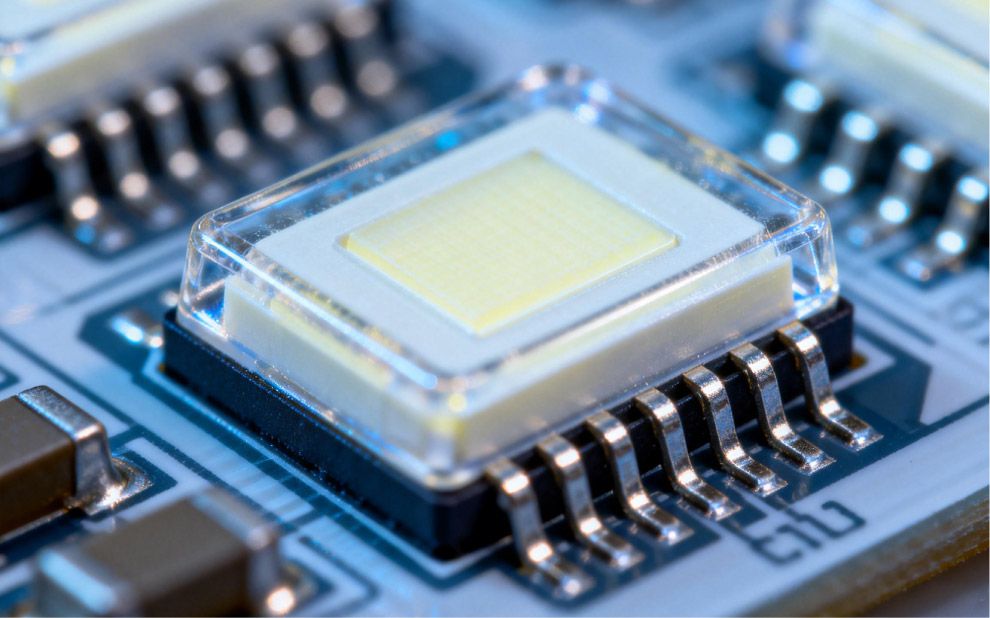
Almost every LED datasheet carries a lifetime figure, usually 50,000 hours, sometimes 100,000. Read casually, it suggests the fitting will run for that long and then fail. Neither half of that is quite right. LEDs rarely fail outright in the way a filament lamp did; they fade. So the industry measures lifetime not as the moment the light goes out, but as the moment it has dimmed past a defined threshold — and it expresses that threshold with a small alphabet of codes that is worth learning to read.
L-values — how much light is left
The L in L70 stands for lumen maintenance. L70 is the number of operating hours until the LED's output has fallen to 70% of its initial value; L80 and L90 are the hours to 80% and 90%. The same LED will therefore have three quite different lifetime figures depending on which threshold is chosen, and a datasheet that says "50,000 hours" without an L-value is leaving out the most important part. L70 is the common commercial benchmark, based on the observation that most people do not notice a gradual 30% loss in a general lighting installation. For task-critical or display applications, L80 or L90 is a more honest measure of useful life.
B-values — how many fittings that applies to
LEDs from the same batch do not all age at the same rate, so a lifetime claim also needs to say what proportion of the population it describes. That is the B-value. L70B50 means that after the stated hours, half the LEDs will still be above 70% output — and half will be below. L70B10 means 90% of them will still be above 70%. B50 is effectively the median; B10 is a much stricter, and more useful, statement about the installation as a whole. When a B-value is missing, B50 is usually what is meant.
Some manufacturers add an F-value (for total failures) or C-value (for abrupt, or "catastrophic", failures) alongside, to account for LEDs that stop working entirely rather than fading. These are less common on general-lighting datasheets but appear on more rigorous ones.
Where the numbers come from: LM-80 and TM-21
Nobody runs an LED for 50,000 hours — nearly six years — before publishing a datasheet. Instead, LED package manufacturers test samples under IES LM-80, which measures lumen maintenance at controlled temperatures and drive currents for a minimum of 6,000 hours, and typically 10,000. IES TM-21 then sets out how far that data may be extrapolated: no more than six times the test duration (five and a half times where fewer than 20 samples were tested). Ten thousand hours of test data can therefore support a claim of up to 60,000 hours; anything beyond that should be reported as ">60,000" rather than as a specific figure. A claim of 100,000 hours L70 requires at least 16,700 hours of LM-80 data behind it, and more with a small sample — which some manufacturers genuinely have, and some do not.
Two caveats matter here. First, LM-80 tests the LED package, not the finished luminaire. The projected lifetime assumes the LED is being run at a temperature no higher than the one it was tested at, which depends entirely on the luminaire's thermal design. Second, a luminaire contains more than LEDs. The driver — with its electrolytic capacitors — is the component most likely to fail first, and its rated life is a separate figure, often shorter, that deserves its own line on the datasheet.
Turning hours into years
- An office running 10 hours a day, 5 days a week, uses around 2,600 hours a year. A 50,000-hour L70 rating is roughly 19 years of gradual decline — well beyond the point at which the building will have been refitted for other reasons.
- A 24-hour car park or hospital corridor uses 8,760 hours a year. The same 50,000 hours is under six years, and the driver's rated life becomes the practical limit.
- A warehouse on two shifts, around 5,000 hours a year, sits in between: ten years to L70, with maintenance planning realistically needed at seven or eight.
- A warranty is a commercial promise, not a lifetime rating. A five-year warranty on a 50,000-hour fitting is entirely consistent; the two numbers answer different questions.
- Ambient temperature shifts everything. A fitting rated at 25°C but installed under a metal roof at 45°C will not reach its published L70, and a good datasheet will show by how much.
A lifetime figure without an L-value, a B-value and a test temperature is not a specification. It is a number.
The practical test for any lifetime claim is whether it can be traced: L70B50 at 50,000 hours, at a stated case temperature, projected from a named LM-80 report under TM-21, with a separate figure for the driver. A manufacturer who can produce that chain of evidence is telling you how their product will behave. One who offers a single round number is, at best, quoting the chip supplier's brochure — and the chip is only part of what you are buying.