
A Guide to UK Lighting Standards
“Is this compliant?” isn't really one question. It's at least five. Here's a working map of where each framework sits and what it actually governs.
Ask a specifier which regulations govern a lighting project and the honest answer is usually “several, and they all do different things.” That's not a flaw in the framework — light output, building energy performance, product efficiency, and product safety are genuinely different questions, and it makes sense that they're governed separately.
BS EN 12464 — how much light, and how good it needs to be
BS EN 12464-1 (indoor workplaces) and its companion, BS EN 12464-2 (outdoor workplaces), are the standards most specifiers reach for first, because they answer the most practical question: how much light does this space need, and to what quality? They set recommended maintained illuminance levels for different tasks and space types — an office desk, a warehouse aisle, a car park, a loading bay — along with related quality criteria like glare limitation (UGR) and colour rendering (Ra). These are the numbers a lighting design is actually calculated against; everything else on this list governs the product and the building around that design, not the light level itself.
Building Regulations Part L — the building's energy performance
Part L of the Building Regulations (Conservation of fuel and power — Scotland has its equivalent Section 6) sits at building level, not product level. It's concerned with the overall energy performance of the building, and for lighting that typically translates into requirements around luminaire efficacy and lighting controls — occupancy sensing, daylight linking, zoning — and how the lighting design contributes to the building's overall energy calculation. It's usually a Part L submission, worked through with the project's energy assessor, that determines whether a lighting scheme as designed is compliant, rather than any single product datasheet in isolation.

Ecodesign / ErP — the product's own efficiency
Separately from the building, the light source and luminaire themselves are subject to product-level energy requirements — historically under the EU's Ecodesign (ErP) framework, with a UK equivalent regime now sitting alongside it. These set minimum efficacy and performance thresholds for products placed on the market, and they're the reason a genuinely inefficient light source generally can't legally be sold into the market at all, independent of how it's used in a specific building.
UKCA and CE marking — is the product legally sellable
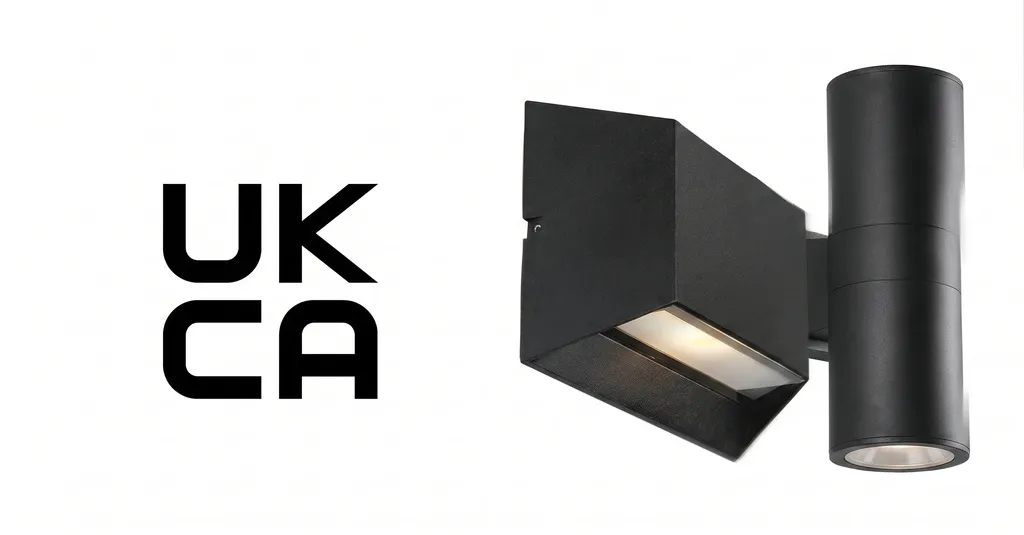
This is a conformity question, not a performance question: does the product meet the relevant safety, electromagnetic compatibility, and other essential requirements to be placed on the market at all? In Great Britain that's demonstrated through UKCA marking; in the EU (and, via the Windsor Framework arrangements, Northern Ireland) it's CE marking. The specific rules and transitional arrangements around which mark is required, and when, have moved more than once since the UK left the EU — the practical takeaway for a specifier is to check current .gov.uk guidance for the live position rather than relying on general industry knowledge, since this is one of the few areas here where the rules have genuinely changed over time.
RoHS — what the product is made of
The Restriction of Hazardous Substances directive (RoHS) governs the materials and components inside electronic products, including lighting — restricting substances like lead, mercury, and certain flame retardants above defined thresholds. It's a manufacturing and materials compliance question, sitting behind the product rather than in front of the specifier, but it's part of the due-diligence pack a professional buyer is entitled to ask a manufacturer for.
Putting it together
- BS EN 12464-1 / -2 — how much light, and how good: the design calculation.
- Building Regs Part L — the building's overall energy performance: the compliance submission.
- Ecodesign / ErP — the product's own efficiency: the market-entry threshold.
- UKCA / CE — is the product legally sellable: the conformity mark.
- RoHS — what's inside the product: the materials compliance.
"Is it compliant?" isn't one question — light level, building energy, product efficiency, and product safety are governed separately, and a specification should be able to answer all five.
None of this needs to be intimidating. In practice, a well-run project addresses each of these at the point where it naturally belongs — illuminance levels in the lighting design, Part L in the energy strategy, and product-level compliance in the manufacturer's own documentation, which a credible supplier should be able to produce on request without difficulty. The goal of this map isn't to turn every specifier into a compliance officer; it's to make clear which question you're actually asking when you ask “is this compliant” — and who has the answer.